Unlock Premium Travel: Maximize Credit Card Transfer Partners for 15% More Value in 2026

In the dynamic world of credit card rewards, simply accumulating points is only half the battle. The true mastery lies in knowing how to redeem them for maximum value. For savvy travelers and points enthusiasts, credit card transfer partners represent the pinnacle of rewards optimization. By strategically transferring your hard-earned points to airline or hotel loyalty programs, you can unlock premium travel experiences that would otherwise be astronomically expensive. In 2026, with evolving program rules and new opportunities, mastering these transfers is more crucial than ever to achieve at least 15% more value from your rewards.
This comprehensive guide will delve deep into the mechanics of credit card transfer partners, equipping you with the knowledge and strategies to elevate your travel game. We’ll explore why direct redemptions often fall short, highlight the major players in the transfer game, and provide actionable tips to ensure you’re getting the most bang for your buck. Get ready to transform your points into unforgettable first-class flights, luxurious hotel stays, and dream vacations.
The Power of Credit Card Transfer Partners: Why Direct Redemptions Fall Short
Many credit card users are content with redeeming their points directly for cashback, gift cards, or travel bookings through their card issuer’s portal. While these options offer convenience, they rarely provide the highest value. Typically, direct redemptions yield a fixed value per point, often around 1 cent per point. For example, 100,000 points might get you $1,000 in statement credit or travel booked through the portal.
However, when you leverage credit card transfer partners, that same 100,000 points can suddenly be worth $1,500, $2,000, or even more, especially for premium international flights or high-end hotel stays. This significant uplift in value is due to the often-disproportionate cost of premium travel if purchased with cash versus the points required through an airline or hotel loyalty program. Airlines and hotels price their premium cabins and suites very differently from economy seats or standard rooms. While a first-class ticket might cost $10,000 cash, it could be available for 100,000 miles through a partner program, effectively giving you 10 cents per point – a 10x increase over cashback!
The key to understanding this discrepancy lies in the internal valuation of points and miles within loyalty programs. These programs often have dynamic pricing, but even with fluctuations, the potential for outsized value remains a cornerstone of the travel hacking world. By understanding and utilizing credit card transfer partners, you’re not just redeeming points; you’re converting them into a currency with a much higher purchasing power for specific, high-value redemptions.
Major Credit Card Transfer Programs and Their Partner Ecosystems
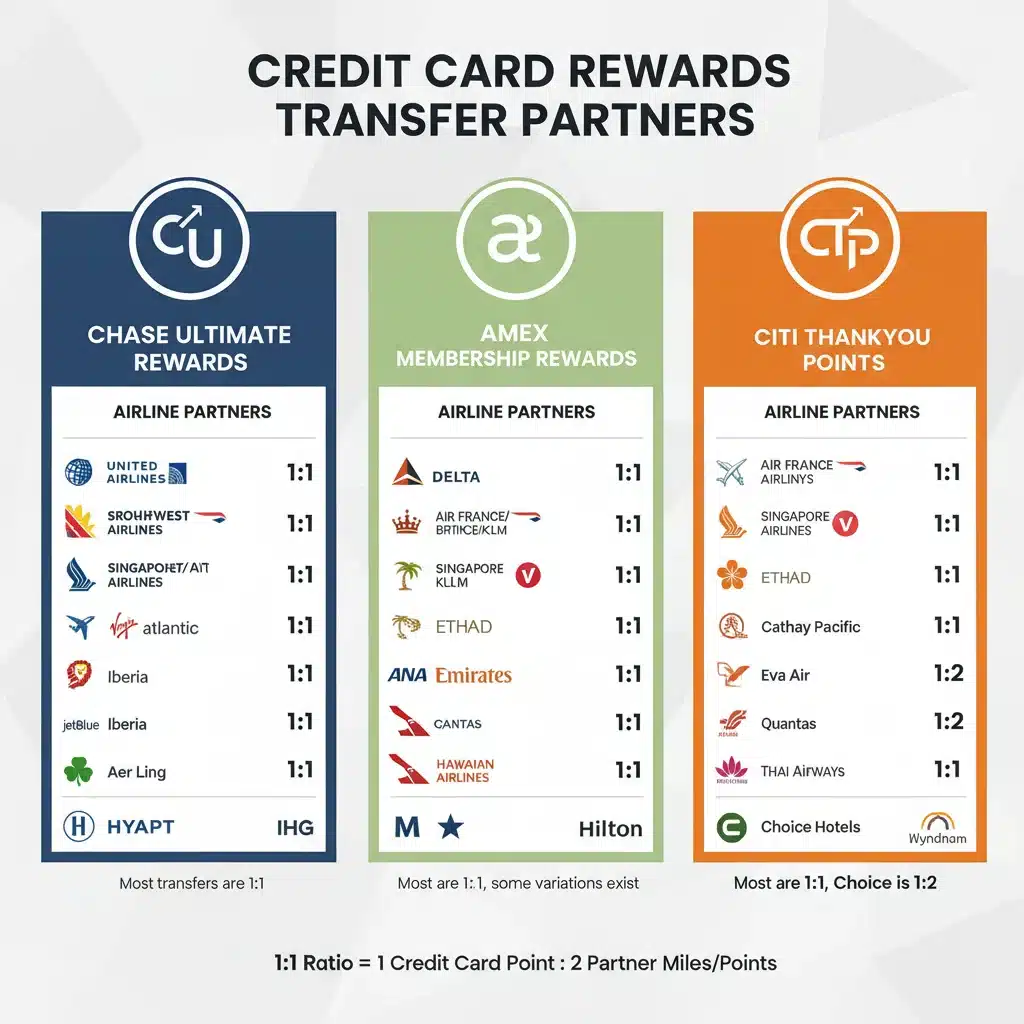
To effectively use credit card transfer partners, you need to know which major transferable points currencies exist and which loyalty programs they partner with. The primary players in the U.S. market are:
1. Chase Ultimate Rewards
Chase Ultimate Rewards is consistently ranked as one of the most valuable transferable points currencies. Points earned from cards like the Chase Sapphire Preferred, Chase Sapphire Reserve, or Chase Freedom Flex can be transferred at a 1:1 ratio to a diverse array of airline and hotel partners. This means 1,000 Ultimate Rewards points become 1,000 airline miles or hotel points.
- Airline Partners: Southwest Airlines Rapid Rewards, United MileagePlus, British Airways Executive Club, Iberia Plus, Aer Lingus AerClub, Air France-KLM Flying Blue, Singapore Airlines KrisFlyer, Virgin Atlantic Flying Club, JetBlue TrueBlue (at a 1:0.8 ratio), Emirates Skywards, and more.
- Hotel Partners: World of Hyatt, IHG One Rewards, Marriott Bonvoy.
World of Hyatt is often considered the ‘sweet spot’ for Chase transfers, regularly yielding 2 cents per point or more for luxury hotel redemptions. United and various Oneworld and SkyTeam partners also offer excellent value for international flights.
2. American Express Membership Rewards
American Express Membership Rewards offers perhaps the broadest selection of airline transfer partners, making it incredibly flexible for international travel. Points from cards like the Amex Platinum Card, Amex Gold Card, or Amex Green Card also transfer at a 1:1 ratio for most partners.
- Airline Partners: Delta SkyMiles, Air Canada Aeroplan, ANA Mileage Club, British Airways Executive Club, Cathay Pacific Asia Miles, Emirates Skywards, Etihad Guest, Hawaiian Airlines HawaiianMiles, Iberia Plus, JetBlue TrueBlue, KLM/Air France Flying Blue, Qantas Frequent Flyer, Singapore Airlines KrisFlyer, Virgin Atlantic Flying Club, and more.
- Hotel Partners: Hilton Honors (1:2 ratio), Marriott Bonvoy (1:1 ratio), Choice Privileges (1:1 ratio).
Amex often runs transfer bonuses, where you might get 20-40% extra miles when transferring to specific partners, further amplifying the value of your credit card transfer partners strategy.
3. Citi ThankYou Rewards
Citi ThankYou Rewards, primarily earned from cards like the Citi Premier Card or Citi Prestige Card, also provides a strong portfolio of airline transfer partners, particularly valuable for international travel. Most transfers are at a 1:1 ratio.
- Airline Partners: Avianca LifeMiles, Cathay Pacific Asia Miles, Emirates Skywards, Etihad Guest, EVA Air Infinity MileageLands, Flying Blue (Air France/KLM), JetBlue TrueBlue, Malaysia Airlines Enrich, Qantas Frequent Flyer, Qatar Airways Privilege Club, Singapore Airlines KrisFlyer, Thai Airways Royal Orchid Plus, Turkish Airlines Miles&Smiles, Virgin Atlantic Flying Club, and more.
- Hotel Partners: Choice Privileges (1:2 ratio), Wyndham Rewards (1:1 ratio).
Citi provides excellent access to Star Alliance partners through Avianca LifeMiles and a strong array of options for Middle East and Asian carriers.
4. Capital One Miles
Capital One Miles, earned from cards like the Capital One Venture X Rewards Credit Card or Capital One Venture Rewards Credit Card, has rapidly expanded its list of transfer partners. Most transfers are at a 1:1 ratio.
- Airline Partners: Aeromexico Rewards, Air Canada Aeroplan, Air France-KLM Flying Blue, Avianca LifeMiles, British Airways Executive Club, Cathay Pacific Asia Miles, Emirates Skywards, Etihad Guest, EVA Air Infinity MileageLands, Finnair Plus, Qantas Frequent Flyer, Singapore Airlines KrisFlyer, Turkish Airlines Miles&Smiles, Virgin Red (Virgin Atlantic), and more.
- Hotel Partners: Accor Live Limitless (2:1 ratio), Wyndham Rewards (1:1 ratio).
Capital One has become a formidable competitor, offering a robust set of partners that overlap with and complement other programs, strengthening the utility of credit card transfer partners for diverse travel needs.
Strategies for Maximizing Value with Credit Card Transfer Partners in 2026
Achieving 15% or more value from your points isn’t just about knowing the partners; it’s about strategic planning and execution. Here’s how to do it in 2026:
1. Identify Your Travel Goals First
Before transferring any points, know where you want to go, when you want to go, and in what class of service (economy, business, first). Different loyalty programs excel for different routes and cabins. For example, if you dream of a luxurious suite at a Park Hyatt, Chase Ultimate Rewards to World of Hyatt is your best bet. If a first-class flight on Emirates is your goal, Amex Membership Rewards or Citi ThankYou Rewards to Emirates Skywards would be ideal.
2. Research Award Availability
This is perhaps the most critical step. Award availability, especially for premium cabins, is limited and can be challenging to find. Do not transfer points until you have confirmed that your desired award is available. Most airline and hotel loyalty programs have online search tools. Some require calling their customer service. Use tools like SeatSpy, ExpertFlyer, or award search engines specific to certain alliances (e.g., United’s website for Star Alliance, British Airways’ for Oneworld) to find availability before committing your points.
3. Understand Transfer Ratios and Bonuses
While most transfers are 1:1, some are not (e.g., Amex to Hilton is 1:2, Chase to JetBlue is 1:0.8). Always confirm the transfer ratio. Furthermore, keep an eye out for transfer bonuses. Credit card issuers frequently offer 15-40% bonuses when transferring to specific partners. A 25% bonus means 100,000 points become 125,000 miles, instantly boosting your value. Time your transfers with these promotions to maximize your rewards.
4. Leverage Sweet Spots and Award Charts
Many loyalty programs have ‘sweet spots’ – specific routes or redemption types where the points required are disproportionately low compared to the cash price. For example, using Avianca LifeMiles for Star Alliance business class flights can be incredibly cheap. Similarly, some hotel programs offer fifth-night free on award stays, further enhancing value. Familiarize yourself with award charts (if available) and common sweet spots for your chosen programs.
5. Be Aware of Transfer Times
While some transfers are instant (e.g., Chase to United, Amex to Delta), others can take hours or even days (e.g., Amex to ANA, Citi to some obscure partners). This is another reason why confirming availability is paramount. If a transfer takes too long, the award seat you found might be gone. Always check typical transfer times before initiating a transfer.
6. Understand Fees and Surcharges
Some airlines, most notably British Airways and Virgin Atlantic, are known for imposing high fuel surcharges on award tickets, especially for international premium cabins. While the points cost might be low, the cash component can be significant. Always factor in these out-of-pocket costs when calculating your overall value. Other airlines, like United or Southwest, typically have minimal to no fuel surcharges on award redemptions.
7. Don’t Transfer Speculatively
Once points are transferred to an airline or hotel loyalty program, they generally cannot be transferred back to the credit card issuer. They are also usually locked into that specific loyalty program. Therefore, only transfer points when you have a concrete redemption in mind and have confirmed availability. Keeping points in their flexible credit card currency is always the safest bet until you’re ready to book.
Top Credit Card Transfer Partners for Premium Travel in 2026
While all partners have their merits, some consistently offer exceptional value for premium travel. Here are a few that stand out for 2026 planning:
Airline Partners:
- Air Canada Aeroplan (Amex, Chase, Capital One): Excellent for Star Alliance business and first-class redemptions, with reasonable surcharges and a flexible award chart. Their partnership with Etihad also opens up unique premium routes.
- Virgin Atlantic Flying Club (Amex, Chase, Citi, Capital One): While known for high surcharges on their own metal, Virgin Atlantic miles are fantastic for partner awards, especially Delta One to Europe or ANA First Class to Japan, with much lower fees.
- Singapore Airlines KrisFlyer (Amex, Chase, Citi, Capital One): The only way to book Singapore Airlines’ coveted Suites Class or their new A380 First Class. Availability can be tight, but the experience is unparalleled.
- United MileagePlus (Chase): Great for domestic and international Star Alliance awards, with no fuel surcharges. Their dynamic pricing can sometimes be high, but sweet spots still exist.
- British Airways Executive Club (Amex, Chase, Capital One): While high surcharges plague long-haul flights, Avios are excellent for short-haul flights on British Airways, Iberia, and American Airlines, especially in economy or business class within Europe or the Caribbean.
- Avianca LifeMiles (Citi, Capital One): A valuable Star Alliance partner with no fuel surcharges and competitive award rates for business and first class.
Hotel Partners:
- World of Hyatt (Chase): Consistently offers the best value for hotel redemptions, especially for luxury properties. Their award chart is fixed, making it easier to find high-value redemptions.
- Marriott Bonvoy (Amex, Chase): While often requiring more points, Marriott’s vast global footprint means you can find a property almost anywhere. Look for fifth-night-free redemptions to boost value.

Real-World Examples: Achieving 15%+ Value with Credit Card Transfer Partners
Let’s illustrate how these strategies translate into tangible savings and premium experiences:
Example 1: First Class to Japan with ANA
Imagine you want to fly first class from the US to Tokyo. A cash ticket can easily cost $15,000-$20,000. However, by transferring 90,000-120,000 Amex Membership Rewards points to Virgin Atlantic Flying Club (often with a transfer bonus), you could book ANA First Class. Even with a small transfer bonus, 100,000 Amex points could become 125,000 Virgin points, sufficient for a one-way first-class ticket. At a cash value of $15,000, this redemption yields an astounding 15 cents per point, far exceeding the 15% target value and demonstrating the power of credit card transfer partners.
Example 2: Luxury Stay at Park Hyatt Maldives
A night at the Park Hyatt Maldives can cost upwards of $1,000. For just 30,000 World of Hyatt points per night (transferred from Chase Ultimate Rewards at 1:1), you can experience this luxury. If you stay for 5 nights, utilizing the fifth-night-free benefit, 120,000 points (30,000 x 4) would get you 5 nights, worth $5,000. This translates to over 4 cents per point, a significant increase over direct redemption options and a clear win for credit card transfer partners.
Example 3: Business Class to Europe with Air France-KLM Flying Blue
A business class ticket from the US to Europe can cost $4,000-$7,000. Flying Blue (a common partner for Amex, Chase, Citi, Capital One) often has promotional ‘Promo Rewards’ for 25% off award flights. Regularly, a one-way business class ticket might be 55,000-70,000 miles. With a 25% transfer bonus and a Promo Reward, you might only need 40,000-50,000 original credit card points for a flight worth $4,000. This redemption would yield 8-10 cents per point, again far surpassing the 15% value target and showcasing the effectiveness of using credit card transfer partners.
Advanced Tips for 2026 and Beyond
- Diversify Your Point Portfolio: Don’t put all your eggs in one basket. Having points in multiple transferable currencies (e.g., Chase and Amex) gives you access to a wider range of partners and increases your flexibility.
- Monitor Program Devaluations: Loyalty programs can change their award charts or transfer ratios with little notice. Stay informed by reading points and miles blogs regularly.
- Consider Family Pooling: Some programs (like British Airways Avios or Air Canada Aeroplan) allow family members to pool their miles, making it easier to accumulate enough for larger redemptions.
- Utilize Stopovers and Open-Jaws: Many airline programs allow stopovers or open-jaws on award tickets, allowing you to visit multiple destinations for the same or slightly higher points cost, adding immense value.
- Leverage Companion Certificates: Some credit cards offer companion certificates (e.g., British Airways Visa Signature Card, Delta SkyMiles Reserve Amex) that can be combined with award tickets, further reducing the points required for two travelers.
The Future of Credit Card Transfer Partners in 2026
As we look towards 2026, the landscape of credit card transfer partners will undoubtedly continue to evolve. Dynamic pricing for award flights is becoming more prevalent, meaning the number of points required for a flight can fluctuate based on demand, time of year, and cash price. This makes it even more critical to be flexible with your travel dates and to book well in advance for peak periods.
However, even with these changes, the fundamental principle remains: transferring points to airline and hotel loyalty programs almost always offers a better redemption value for premium travel than direct booking through a credit card portal or cashback. The 15% additional value we’ve discussed is a conservative estimate; with smart planning and a bit of luck with transfer bonuses and sweet spots, you can often achieve much, much more.
The competitive nature of the credit card market means issuers will continue to offer attractive sign-up bonuses and benefits, ensuring a steady supply of transferable points. New partnerships may emerge, and existing ones may strengthen or shift. Staying informed and adaptable will be key to consistently maximizing your rewards.
Conclusion: Your Passport to Premium Travel
Mastering credit card transfer partners is not just a hobby for the travel-obsessed; it’s a powerful financial strategy that can unlock unparalleled travel experiences. By understanding the different transferable currencies, their respective partners, and the best strategies for redemption, you can routinely achieve 15% or more in value from your credit card points.
In 2026, don’t settle for mediocre redemptions. Plan your travel goals, research award availability diligently, pounce on transfer bonuses, and strategically move your points to the programs that offer the best value for your dream trips. Whether it’s a lie-flat seat across the ocean, a luxurious overwater bungalow, or an exclusive experience, your credit card points hold the key. Start exploring the world of credit card transfer partners today and transform your points into priceless memories.