2026 Guide: Transfer Loyalty Points Efficiently & Save Fees

The 2026 Guide to Transferring Loyalty Points Efficiently Between US Programs: Save 30% on Fees
In the dynamic landscape of loyalty programs, mastering the art of how to transfer loyalty points efficiently is not just a skill—it’s a financial superpower. For 2026, the strategies for maximizing your rewards and minimizing associated costs have evolved, making it more crucial than ever to stay informed. This comprehensive guide will equip you with the knowledge to navigate the complex world of point transfers between major US loyalty programs, helping you save up to 30% on fees and unlock unparalleled value from your hard-earned points.
The ability to seamlessly move points between different programs can transform a standard redemption into an extraordinary experience, whether it’s a first-class flight, a luxurious hotel stay, or a significant discount on everyday purchases. However, without a clear understanding of transfer ratios, partner networks, and, critically, the fees involved, you risk diluting the value of your rewards. As we step into 2026, new opportunities and challenges present themselves, demanding a fresh look at our point transfer strategies.
Understanding the Core Principles of Loyalty Point Transfers in 2026
Before diving into specific programs and fee-saving tactics, it’s essential to grasp the foundational concepts of how to transfer loyalty points. Loyalty programs, particularly those associated with credit cards, airlines, and hotels, are designed to incentivize customer loyalty. However, their true power often lies in their flexibility – the ability to convert points from one program into another, typically with a partner.
What Exactly Are Loyalty Point Transfers?
At its heart, a loyalty point transfer is the process of moving points or miles you’ve accumulated in one loyalty program (the transferor) to another program (the transferee), usually a partner airline or hotel chain. For instance, you might earn points with a credit card like Chase Ultimate Rewards or American Express Membership Rewards, and then transfer those points to a participating airline’s frequent flyer program (e.g., United MileagePlus or Delta SkyMiles) to book a flight.
This flexibility is what makes transferable points so valuable. Instead of being locked into one airline or hotel brand, you gain access to a wider array of redemption options, often at much higher per-point values than direct redemptions through the original program’s portal. In 2026, the strategic use of these transfers is paramount for maximizing your travel budget.
Why Transferring Points is Crucial for Value Maximization
Direct redemptions for cash back or gift cards typically yield a fixed and often lower value per point (e.g., 1 cent per point). However, by choosing to transfer loyalty points to airline or hotel partners, you can frequently achieve significantly higher values, sometimes two, three, or even five cents per point, especially for premium cabin international travel or luxury hotel stays. This disparity in value is the primary reason savvy travelers prioritize transfers.
Furthermore, transfer bonuses are a common occurrence, especially in 2026. Credit card programs often run promotions where they offer an additional percentage of points when you transfer to a specific partner. For example, a 25% transfer bonus means that for every 1,000 credit card points you transfer, you receive 1,250 points in the partner program. These bonuses are critical opportunities to supercharge your point balances and are central to saving money.
Navigating the Major US Loyalty Programs for Efficient Transfers in 2026
The US market is dominated by several key transferable points programs, each with its unique set of partners, transfer ratios, and nuances. Understanding these differences is the first step to truly efficient point management. We’ll focus on the major players and their 2026 landscape.
Chase Ultimate Rewards (UR)
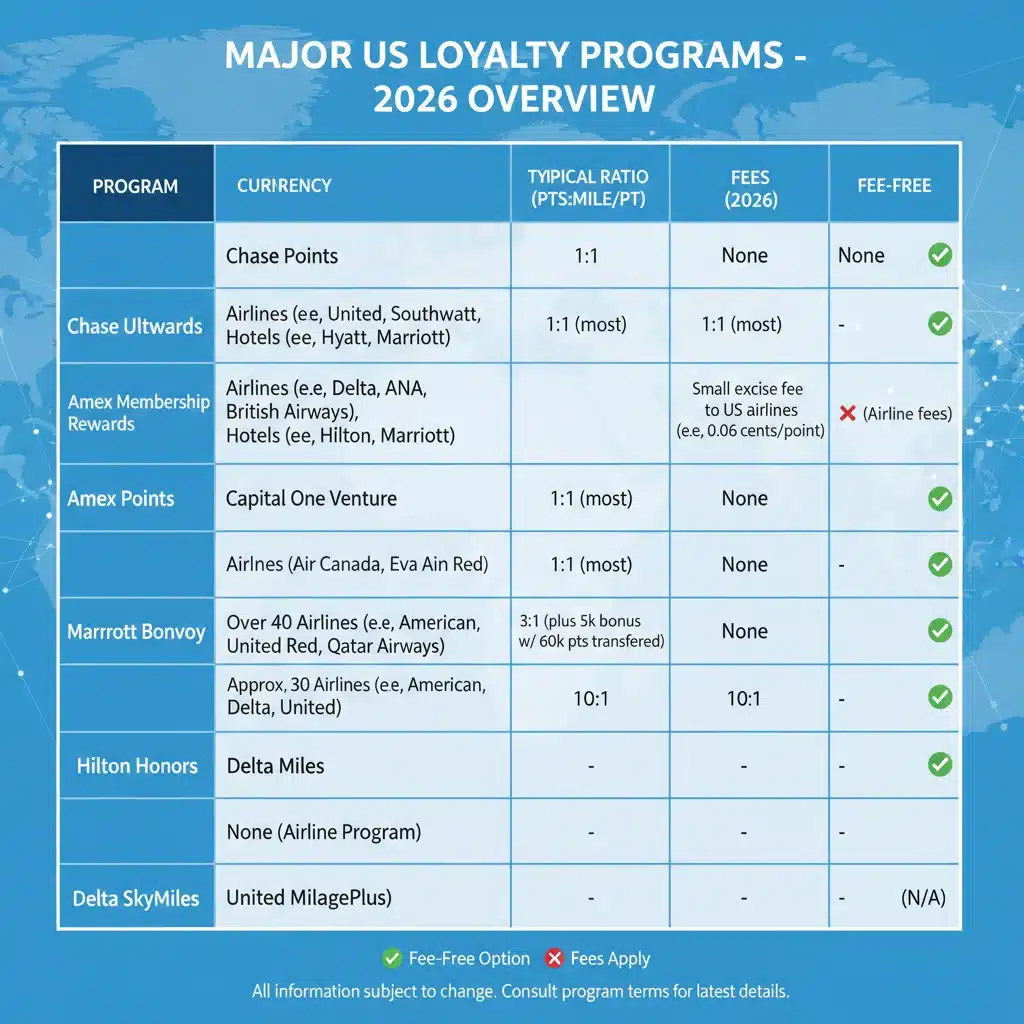
Chase Ultimate Rewards remains a powerhouse in 2026 due to its valuable 1:1 transfer partners. These include airlines like United Airlines, Southwest Airlines, British Airways, Singapore Airlines, Virgin Atlantic, and Air France/KLM Flying Blue, as well as hotels such as Hyatt and Marriott. Hyatt, in particular, is often cited as a sweet spot for UR transfers due to its excellent redemption value.
Key features for 2026:
- 1:1 Transfer Ratio: Most partners maintain this favorable ratio.
- Transfer Times: Generally instant for most partners, which is crucial for booking time-sensitive awards.
- Fees: Chase rarely charges fees for transfers to its travel partners, making it highly attractive for cost-conscious travelers. This is a significant advantage when you want to transfer loyalty points without incurring extra costs.
- Best Use Cases: Premium cabin international flights and high-value Hyatt hotel stays.
American Express Membership Rewards (MR)
American Express Membership Rewards offers an extensive list of airline and hotel transfer partners, making it incredibly versatile. Notable airline partners include Delta SkyMiles, Emirates Skywards, ANA Mileage Club, Cathay Pacific Asia Miles, and Avianca LifeMiles, alongside hotel partners like Marriott Bonvoy and Hilton Honors.
Key features for 2026:
- Vast Partner Network: One of the broadest selections, offering flexibility for diverse travel plans.
- Transfer Ratios: Mostly 1:1 for airlines, but some hotel partners (e.g., Hilton) have less favorable ratios (1:2).
- Fees: Amex charges a small excise tax offset fee for transfers to US-based airlines (0.06 cents per point, up to a maximum of $99). While minor, it’s a fee to be aware of when you transfer loyalty points.
- Transfer Times: Varies, with some instant and others taking up to 48 hours.
- Best Use Cases: Leveraging transfer bonuses for international business/first class flights.
Citi ThankYou Points (TYP)
Citi ThankYou Points provide another strong contender for transferable points, with a focus on international airline partners. Key partners include Avianca LifeMiles, Turkish Airlines Miles&Smiles, Singapore Airlines KrisFlyer, and Virgin Atlantic Flying Club. Hotel partners are typically limited to Choice Privileges and Wyndham Rewards.
Key features for 2026:
- International Airline Focus: Excellent for travelers looking to fly specific international carriers.
- 1:1 Transfer Ratio: Standard for most airline partners.
- Fees: Citi generally does not charge fees for transferring points to its partners, making it a competitive option for fee-free transfers.
- Transfer Times: Can vary from instant to a few days.
- Best Use Cases: Booking Star Alliance and SkyTeam flights through partners like Avianca and Virgin Atlantic.
Capital One Miles
Capital One Miles have grown significantly in value and flexibility, especially with their enhanced transfer partner list. Partners include airlines like Air Canada Aeroplan, British Airways Executive Club, Turkish Airlines Miles&Smiles, and Virgin Red, along with hotel programs such as Wyndham Rewards.
Key features for 2026:
- Competitive Partner List: Strong options for both domestic and international travel.
- Improved Transfer Ratios: Most partners now transfer at a 1:1 ratio, a significant improvement from previous years.
- Fees: Capital One does not charge fees for transferring miles to its partners, making it another excellent choice for fee-conscious transfers.
- Transfer Times: Generally instant or within 24 hours.
- Best Use Cases: Flexible travel redemptions across various alliances.
Bilt Rewards
Bilt Rewards, while newer, has quickly established itself as a major player, especially for renters, by allowing rent payments to earn points without transaction fees. Its transfer partners are robust and include American Airlines AAdvantage (a unique direct transfer option), United MileagePlus, Hyatt, and Emirates Skywards.
Key features for 2026:
- Unique Partner Access: Direct transfer to American Airlines is a huge differentiator.
- 1:1 Transfer Ratio: All partners transfer at 1:1.
- Fees: Bilt charges no fees for transfers, solidifying its position as a top choice for maximizing value.
- Transfer Times: Typically instant.
- Best Use Cases: Renters looking to earn and transfer points to premium travel partners.
Strategies to Save 30% or More on Loyalty Point Transfer Fees in 2026
Reducing or eliminating transfer fees is paramount to maximizing the value of your points when you transfer loyalty points. While some programs are inherently fee-free, others have nuances that can be exploited for savings. Here’s how to achieve significant fee reductions in 2026:
1. Prioritize Fee-Free Transfer Programs
The most straightforward way to save on fees is to simply choose programs that don’t charge them. Chase Ultimate Rewards, Capital One Miles, Citi ThankYou Points, and Bilt Rewards are excellent examples of programs that generally allow you to transfer loyalty points to their partners without additional charges. If your travel goals can be met through their respective partner networks, these programs should be your first consideration.
By focusing your point accumulation on cards that earn these types of transferable points, you inherently build a strategy that avoids the common pitfalls of transfer fees.
2. Understand and Mitigate Amex Excise Tax Offset Fees
American Express Membership Rewards is the primary program that imposes a fee for transfers to US-based airlines. While the fee is small (0.06 cents per point, capped at $99), it can add up for large transfers. Here’s how to manage it:
- Transfer to Non-US Airlines: If your travel plans allow, consider transferring to international airline partners (e.g., Emirates, Singapore Airlines, ANA) where this fee does not apply.
- Small Transfers: For smaller transfers, the fee is negligible. For example, transferring 10,000 points incurs a $6 fee.
- Factor into Value: Always factor this small fee into your overall redemption value calculation. Even with the fee, transferring to a premium airline partner often yields a significantly higher value than other redemption options.
3. Leverage Transfer Bonuses
While not directly a fee reduction, transfer bonuses effectively reduce the cost per point of your redemption. If a program offers a 25% bonus to a partner, you’re essentially getting 25% more points for the same transfer, which can easily offset any minor fees or provide a substantial boost in value. Always be on the lookout for these promotions, as they are a key strategy for maximizing your rewards when you transfer loyalty points.
4. Consolidate Points Strategically
Sometimes, the best way to avoid fees or achieve a better redemption is to consolidate points. For example, if you have points with multiple credit card programs, assess which program offers the best transfer options for your specific travel goal, considering both partner availability and fee structures. Focus on transferring from the program that offers fee-free options first.
5. Consider Alternative Redemption Paths
Before initiating a transfer, always check if there’s an alternative, fee-free way to achieve your redemption. For instance, some credit card portals allow you to book travel directly using points, sometimes at an elevated value (e.g., Chase Sapphire Reserve offers 1.5 cents per point). While this might not always yield the highest per-point value compared to a strategic transfer, it’s completely fee-free and can be a good option if transfer fees are a concern and you’re not aiming for ultra-premium redemptions.
Advanced Strategies for Maximizing Value When You Transfer Loyalty Points in 2026
Beyond simply avoiding fees, there are advanced tactics to ensure you’re getting the absolute most out of your loyalty points in 2026.
Understanding Dynamic Pricing and Award Charts
The travel industry is increasingly moving towards dynamic pricing for award redemptions, meaning the number of points required for a flight or hotel stay fluctuates based on demand, cash price, and other factors. While this can make planning more challenging, it also presents opportunities.
- Flexibility is Key: If you have flexible travel dates, you can often find significantly cheaper award space.
- Search Multiple Partners: Don’t just check one airline partner. For example, if you want to fly a Star Alliance airline, check award availability through United, Avianca LifeMiles, and Singapore Airlines, as each might have different availability or pricing for the same flight.
- Utilize Award Search Tools: Tools like ExpertFlyer or specific airline award calendars can help you identify optimal redemption windows.
The Power of Sweet Spots
Every loyalty program has its ‘sweet spots’ – specific redemptions that offer exceptionally high value. For example:
- Hyatt with Chase UR: Often considered one of the best hotel redemptions, especially for luxury properties.
- Virgin Atlantic Flying Club for Delta/ANA: Despite being a SkyTeam partner, Virgin Atlantic can sometimes offer incredible value for Delta One flights or ANA First/Business Class flights from the US.
- Avianca LifeMiles for Star Alliance: Known for competitive rates and often lower fuel surcharges on Star Alliance flights.
Researching and understanding these sweet spots will ensure that when you transfer loyalty points, you’re doing so for the highest possible return.
Booking Companion Passes and Stopovers
Some airline programs offer valuable perks that enhance the value of your transferred points. For instance, some programs allow for free stopovers on award tickets, turning a single destination trip into a multi-city adventure for no additional points. Others offer companion passes after meeting certain spending requirements, effectively doubling the value of your points for two people.
Timing Your Transfers
Given that some transfers aren’t instant, timing is crucial. If you find an award flight or hotel room you want to book, ensure you have sufficient time for the points to transfer. It’s often advisable to call the airline or hotel program to put the award on hold (if possible) while your points transfer. Never transfer points speculatively without a concrete redemption plan, as transfers are almost always irreversible.
Common Pitfalls to Avoid When Transferring Loyalty Points in 2026
Even with the best intentions, mistakes can happen. Being aware of these common pitfalls can save you time, money, and frustration.
Transferring to the Wrong Program
Double-check the program name and account number before initiating a transfer. A typo can send your points into the void or to the wrong person, and reversing such a mistake is often impossible.
Ignoring Transfer Ratios and Minimums
Not all transfers are 1:1. Some programs have less favorable ratios (e.g., 1,000 credit card points become 500 airline miles). Always confirm the ratio. Additionally, some programs have minimum transfer amounts (e.g., must transfer in increments of 1,000 points).
Forgetting About Expiration Dates
While transferable points from credit cards generally don’t expire as long as your account is open and in good standing, points transferred to airline or hotel programs might have their own expiration policies. Be aware of these dates to prevent your hard-earned points from vanishing.
Overlooking Fuel Surcharges and Taxes
While points cover the base fare of a flight or the room rate of a hotel, you will almost always be responsible for taxes and fees. Some airlines, particularly those based in Europe, are notorious for high fuel surcharges on award tickets. Always check the total cash co-pay before you transfer loyalty points, as a high surcharge can significantly diminish the value of your redemption.

Not Confirming Award Availability Before Transferring
This is perhaps the biggest and most costly mistake. Always, always, ALWAYS confirm that the award space you want is available and bookable before you initiate a point transfer. Points transfers are almost always irreversible. If you transfer points and then find the award space is gone, you’re stuck with points in a partner program that might not be useful for your next redemption.
The Future of Loyalty Point Transfers: What to Expect in 2026 and Beyond
The loyalty landscape is continually evolving. In 2026, we can expect a continuation of several trends:
- Dynamic Pricing Expansion: More airlines and hotels will likely adopt dynamic pricing models, requiring greater flexibility and strategic searching from consumers.
- Increased Competition: Newer players like Bilt Rewards will continue to push established programs to offer competitive transfer options and benefits.
- Focus on Ecosystems: Programs will likely continue to strengthen their internal ecosystems and partnerships, making it even more important to understand which programs align best with your travel goals.
- Personalized Offers: Expect more personalized transfer bonuses and redemption opportunities based on your spending and travel patterns.
Staying agile and informed will be key to successfully navigating these changes and continuing to get exceptional value when you transfer loyalty points.
Conclusion: Master Your Points, Master Your Travel in 2026
The ability to transfer loyalty points efficiently between US programs is a cornerstone of savvy travel hacking and reward maximization in 2026. By understanding the intricacies of each major program, strategically avoiding or minimizing fees, and leveraging advanced redemption tactics, you can unlock incredible travel experiences that would otherwise be out of reach.
Remember to prioritize fee-free transfers where possible, keep an eye out for lucrative transfer bonuses, and always confirm award availability before making any irreversible moves. With this guide, you are well-equipped to navigate the complex, yet rewarding, world of loyalty point transfers, saving up to 30% or more on fees and transforming your travel dreams into reality. Start planning your 2026 adventures now, armed with the knowledge to make every point count!