Maximize Loyalty Points: 2026 Guide to 15% More Travel Value in the US
Maximize Your Loyalty Points: A 2026 Guide to Redeeming for 15% More Value on Travel in the US
In the dynamic world of travel rewards, understanding how to maximize loyalty points is not just a hobby—it’s a strategic advantage. As we look towards 2026, the landscape of airline and hotel loyalty programs continues to evolve, presenting both challenges and incredible opportunities for savvy travelers. This comprehensive guide is designed to equip you with the knowledge and tactics needed to redeem your loyalty points for at least 15% more value when traveling within the United States. Forget basic redemptions; we’re talking about unlocking premium experiences, stretching your travel budget further, and making your dream US trips a reality, all by learning how to truly maximize loyalty points.
The allure of free travel is powerful, but the true art lies in maximizing the value of those ‘free’ points. Many travelers accumulate points without a clear strategy, often settling for suboptimal redemption rates. This guide aims to change that. We’ll delve into the intricacies of various loyalty programs, highlight hidden gems, and provide actionable advice to ensure every point you’ve earned works harder for you. From understanding transfer bonuses to identifying sweet spots in award charts, mastering how to maximize loyalty points will transform your travel planning.
Why 15% more value? Because with informed decisions and strategic planning, this is an entirely achievable goal. In a competitive travel market, every percentage point counts, and a 15% increase can translate into significant savings, better accommodations, or more memorable experiences. Let’s embark on this journey to maximize loyalty points and redefine your 2026 US travel adventures.
Understanding the Loyalty Landscape in 2026: Key Changes and Opportunities
The loyalty program ecosystem is constantly shifting. Airlines and hotels frequently adjust their award charts, introduce new partnerships, and modify redemption rules. Staying abreast of these changes is crucial to maximize loyalty points. For 2026, we anticipate a continued trend towards dynamic pricing for award flights and hotel stays, meaning the number of points required will fluctuate based on demand and cash prices. While this can make fixed-value redemptions less predictable, it also opens up opportunities for exceptional value during off-peak periods or when specific promotions arise.
Airline Loyalty Programs: Navigating Dynamic Pricing and Partner Redemptions
US airlines, such as American Airlines AAdvantage, Delta SkyMiles, and United MileagePlus, have largely transitioned to dynamic pricing models. This means that instead of a fixed award chart, the cost of a flight in points is often tied to the cash price of the ticket. While this can make it harder to find ultra-low point redemptions for popular routes, it also means that when cash prices are low, point prices can be equally attractive.
- American Airlines AAdvantage: Look for Web Specials. These are often dynamically priced but can offer significant savings, especially for domestic routes. Leveraging partner airlines like Alaska Airlines can also provide excellent value, particularly for specific routes not directly served by AA or when AA’s dynamic pricing is inflated.
- Delta SkyMiles: Delta’s dynamic pricing can be notoriously high for popular routes. However, they frequently run ‘flash sales’ on award travel, which can offer incredible value. Keeping an eye on these limited-time offers is key to maximizing SkyMiles. Consider using SkyMiles for upgrades or for travel to smaller regional airports where cash fares might be disproportionately high.
- United MileagePlus: United’s Excursionist Perk, though sometimes overlooked, can offer a free one-way flight within a multi-city itinerary. This is a fantastic way to maximize loyalty points if your travel plans involve multiple stops in different regions. Also, United’s extensive network of Star Alliance partners provides numerous opportunities for international and domestic redemptions at potentially better rates than direct United flights.
- Southwest Rapid Rewards: Southwest’s points value is directly tied to the cash price of the ticket, making it straightforward to calculate value. The best way to maximize loyalty points with Southwest is to book during their frequent sales, where cash prices (and thus point prices) are lower. The Companion Pass is also an unparalleled benefit for frequent Southwest flyers, effectively doubling the value of your points for a companion.
Hotel Loyalty Programs: Sweet Spots and Strategic Stays
Hotel loyalty programs like Marriott Bonvoy, Hilton Honors, and World of Hyatt also present unique strategies to maximize loyalty points. While dynamic pricing is becoming more common, many programs still offer award charts or category-based pricing that can be exploited for outsized value.
- Marriott Bonvoy: Marriott’s award chart is zone-based, and they often offer ‘Stay 5, Pay for 4’ redemptions, where the lowest-point night in a five-night stay is free. This is a prime example of how to maximize loyalty points for longer trips. Look for Category 1-4 hotels for excellent value, especially in less touristy areas or during off-peak seasons. Transferring points to airline partners can also be beneficial, especially with transfer bonuses.
- Hilton Honors: Hilton has moved to a more dynamic pricing model, but they still offer fifth-night free on award stays for elite members. This benefit alone can significantly increase the value of your points. Hilton also frequently runs promotions for earning bonus points, making it easier to accumulate a substantial balance. Focus on properties where cash rates are particularly high to get the most bang for your points.
- World of Hyatt: Widely regarded as having one of the most valuable hotel loyalty programs, World of Hyatt offers a fixed award chart, making it easier to predict redemption values. Their points often yield higher per-point value than competitors. Look for Category 1-4 hotels, especially during peak seasons when cash rates skyrocket. Their transfer partners, though fewer, can also be valuable.
Advanced Strategies to Maximize Loyalty Points by 15% or More
Achieving a 15% increase in value requires moving beyond basic redemptions. Here are some advanced strategies to consider for your 2026 US travel plans:
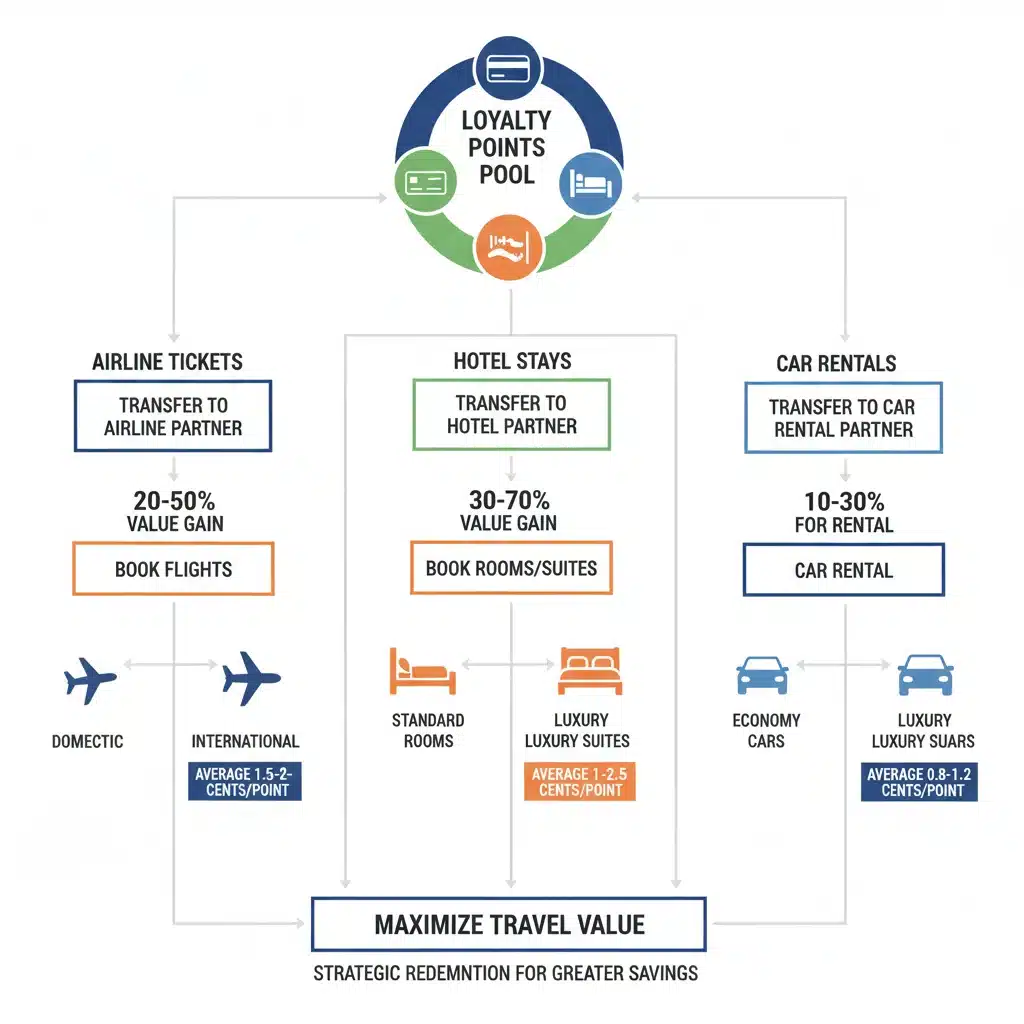
1. Leverage Transfer Bonuses: The Easiest Way to Boost Value
Many flexible points currencies, like Chase Ultimate Rewards, American Express Membership Rewards, and Citi ThankYou Points, periodically offer transfer bonuses to their airline and hotel partners. These bonuses can range from 10% to 50% or even more, effectively increasing the number of miles or points you receive when you transfer. For example, a 25% transfer bonus means 1,000 flexible points become 1,250 airline miles. This is a straightforward way to maximize loyalty points without earning more of the base currency.
- Actionable Tip: Keep a close watch on announcements from your flexible points programs. Only transfer points when there’s a bonus that aligns with your travel plans. Don’t transfer speculatively, as points generally cannot be transferred back.
2. Identify and Exploit ‘Sweet Spots’ in Award Charts
Despite the move to dynamic pricing, some loyalty programs still have specific routes or property categories where the points required are disproportionately low compared to the cash price. These are known as ‘sweet spots’ and are golden opportunities to maximize loyalty points.
- Example: A specific airline might offer a fixed-point redemption for short-haul flights that would otherwise be expensive in cash. Or a hotel chain might have a high-end property in a specific city that remains in a lower award category than its peers.
- Actionable Tip: Regularly review partner award charts (if applicable) and explore different routes and dates. Forums and specialized blogs are excellent resources for identifying current sweet spots.
3. Combine Points and Cash for Optimal Value
Some programs allow you to use a combination of points and cash for redemptions. While sometimes this offers poor value, other times it can be incredibly strategic, especially if you’re slightly short on points for a high-value redemption. Evaluate the cash co-pay carefully to ensure you’re still getting a good per-point value.
4. Consider Downgrading or Upgrading Award Categories
For hotel programs, sometimes booking a slightly lower category hotel and using points for an upgrade at check-in (if available) can provide better overall value than booking a higher category directly. Conversely, if a higher category offers disproportionately better amenities for a small point increase, it might be worth the upgrade to maximize loyalty points for comfort and experience.
Strategic Accumulation: Earning Points Smarter, Not Harder
While redemption is key, smart accumulation is the foundation of how to maximize loyalty points. Don’t just earn points; earn the right points at the right time.
Credit Card Sign-Up Bonuses: Your Fast Track to Points
The quickest way to accumulate a large sum of points is through credit card sign-up bonuses. Many travel rewards cards offer tens of thousands of points (or even hundreds of thousands) after meeting a minimum spending requirement. These bonuses alone can fund entire trips.
- Actionable Tip: Research cards that align with your spending habits and travel goals. Focus on flexible points currencies (Chase Ultimate Rewards, Amex Membership Rewards, Citi ThankYou Points, Capital One Miles) as they offer the most redemption versatility. Be mindful of credit score impacts and annual fees.
Category Bonuses and Everyday Spending
Many credit cards offer bonus points for spending in specific categories, such as dining, groceries, gas, or travel. Align your spending with these categories to accelerate your points accumulation.
- Actionable Tip: Use the right card for the right purchase. For example, if one card offers 3x points on dining and another offers 1x, always use the 3x card for restaurant bills.
Shopping Portals and Dining Programs
Before making any online purchase, check if your airline or hotel loyalty program has a shopping portal offering bonus points. Similarly, dining programs allow you to earn points for eating at participating restaurants simply by linking your credit card.
- Actionable Tip: Make it a habit to check shopping portals like Rakuten (formerly Ebates, which offers Amex Membership Rewards or cash back), airline e-shopping malls, and hotel dining programs before any online purchase or restaurant visit.
Case Studies: Achieving 15%+ Value on US Travel in 2026
Let’s illustrate how these strategies can play out in real-world scenarios to maximize loyalty points for your US travel.
Case Study 1: Cross-Country Flight with Transfer Bonus
Imagine you need to fly from New York to Los Angeles. A direct flight on United might cost 25,000 miles or $350. However, you have 20,000 Chase Ultimate Rewards points. You notice Chase is running a 30% transfer bonus to United’s partner, Air Canada Aeroplan. Transferring your 20,000 Chase points yields 26,000 Aeroplan points.
Aeroplan’s award chart for flights between the US East Coast and West Coast might be 20,000 points. You book the same United flight (via Aeroplan as a Star Alliance partner) for 20,000 Aeroplan points, saving 5,000 miles compared to booking directly with United. The cash value of this flight is $350. Your 20,000 Chase points effectively saved you $350, giving you 1.75 cents per point ($350 / 20,000 points). If you traditionally valued Chase points at 1.25 cents (e.g., through the Chase travel portal), this represents a 40% increase in value!
Value Gained: An impressive 40% increase in value compared to a typical 1.25 cpp redemption.
Case Study 2: Luxury Hotel Stay for a Fraction of the Cost
You’re planning a weekend getaway to Miami and want to stay at a high-end Marriott Bonvoy property that costs $600 per night or 50,000 Bonvoy points. You have 100,000 Bonvoy points and plan to stay for two nights.
Instead of booking two separate nights, you aim for a five-night stay (even if you only use two) to leverage the ‘Stay 5, Pay for 4’ benefit if you have elite status (or can achieve it). Let’s assume you’ve accumulated enough for three nights, and the cash rate is $600/night. booking 3 nights would cost 150,000 Bonvoy points. If you only need 2 nights, you could book the 5 nights (200,000 points for 4 nights, 1 free) and effectively pay 40,000 points per night for a $600 room. This is 1.5 cents per point ($600 / 40,000 points). Many value Bonvoy points at 0.7-0.8 cents per point, so this is a significant increase.
Alternatively, if you only need two nights, and the cash price is $600/night, using 50,000 points per night gives you 1.2 cents per point. If you have a credit card that gives 10% back in points on Marriott stays, or you transfer flexible points during a 20% bonus period, you can easily push this value higher. For example, if you transferred 40,000 Amex points during a 25% bonus to get 50,000 Bonvoy points, your effective Amex point value jumps to 1.5 cents per point ($600 / 40,000 Amex points), a 20% increase over the standard 1.2 cents per point often seen with Amex points.
Value Gained: Up to 20% increase in value by strategically combining transfer bonuses and program benefits.
Pitfalls to Avoid When Redeeming Points
While the goal is to maximize loyalty points, it’s equally important to avoid common mistakes that can diminish their value.
- Don’t Redeem for Low Value: Avoid redeeming points for gift cards, merchandise, or cash back unless the redemption rate is exceptionally high. These options almost always offer significantly less value than travel redemptions.
- Beware of Expiration Dates: Some points have expiration dates. Keep track of these to avoid losing your hard-earned rewards. Engage in qualifying activities (like earning or redeeming a small amount of points) to extend their validity.
- Don’t Transfer Speculatively: Once points are transferred to an airline or hotel partner, they generally cannot be transferred back. Only transfer when you have a specific redemption in mind and have confirmed availability.
- Watch Out for High Fees: While rare for domestic US travel, some international award tickets can incur significant fuel surcharges or taxes. Always check the total cost (points + cash) before booking.
- Understand Dynamic Pricing Fluctuations: If a program uses dynamic pricing, monitor prices over time. Booking too early or too late can sometimes lead to higher point costs. Flexibility is your friend.
Looking Ahead to 2026: What Else to Expect?
As we move further into 2026, expect loyalty programs to continue innovating. Personalized offers based on your travel history and preferences are likely to become more prevalent. AI-driven recommendations for redemption opportunities could also emerge, making it easier for travelers to identify high-value options.
New partnerships between airlines, hotels, and even non-travel brands are also a constant. These partnerships can create new avenues for earning and burning points, offering more ways to maximize loyalty points. Staying informed through industry news, loyalty blogs, and program updates will be more important than ever.
The focus on sustainability in travel may also influence loyalty programs. We might see options to redeem points for carbon offsets or for stays at eco-friendly properties, potentially with bonus points or enhanced value. This aligns with a growing consumer preference for responsible travel.

Tools and Resources to Help You Maximize Loyalty Points
Navigating the complex world of loyalty programs doesn’t have to be a solo mission. Several tools and resources can significantly aid your quest to maximize loyalty points:
- Award Search Engines: Websites like AwardHacker, Point.me, and Seats.aero can help you find award availability and compare redemption rates across different programs. While some require subscriptions, the insights they provide can be invaluable.
- Loyalty Program Trackers: Tools like AwardWallet allow you to track all your loyalty program balances in one place, helping you monitor expiration dates and overall point wealth.
- Blogs and Forums: Sites like The Points Guy, Doctor of Credit, and FlyerTalk are goldmines of information, offering the latest news on transfer bonuses, sweet spots, and advanced strategies. Community forums are also excellent for asking specific questions and learning from experienced travelers.
- Credit Card Comparison Sites: Before applying for a new credit card, use sites that compare sign-up bonuses, earning rates, and annual fees to find the best fit for your strategy to maximize loyalty points.
Conclusion: Your Path to 15% More Travel Value
Mastering how to maximize loyalty points for your 2026 US travel is an achievable goal that can significantly enhance your travel experiences. By understanding the evolving loyalty landscape, strategically accumulating points through credit card bonuses and everyday spending, and employing advanced redemption tactics like transfer bonuses and sweet spot identification, you can consistently achieve and even exceed a 15% increase in value.
The key is proactive learning and strategic planning. Don’t just collect points; actively seek out the best ways to redeem them. Stay informed about program changes, leverage available tools, and don’t be afraid to experiment with different redemption options. With dedication, your loyalty points will unlock more luxurious, more frequent, and ultimately, more fulfilling travel experiences across the United States in 2026 and beyond.
Start planning your next adventure today, armed with the knowledge to truly maximize loyalty points. Happy travels!