Unlock 10% More Value: Your 2026 Guide to Loyalty Point Redemption

In an increasingly competitive landscape, loyalty programs have become a cornerstone of consumer engagement. From credit card rewards to airline miles and hotel points, these programs offer a tantalizing promise: free travel, exclusive experiences, and tangible savings. However, the true art lies not just in accumulating points, but in mastering their redemption. For 2026, the savvy consumer isn’t just redeeming; they’re aiming for a minimum of 10% higher value on their loyalty points redemption. This comprehensive guide will equip you with the strategies, insights, and practical solutions to turn that aspiration into a reality, significantly impacting your financial well-being and lifestyle.
The world of loyalty programs is dynamic, with rules, partnerships, and redemption values constantly evolving. What was a great deal last year might be mediocre today, and what’s emerging as a top-tier redemption option for 2026 could be a game-changer. Our focus here is on proactive strategies that go beyond the obvious, helping you extract maximum value from your hard-earned points. We’ll delve into understanding point valuations, identifying high-value redemption opportunities, leveraging transfer partners, and navigating the often-complex terms and conditions to ensure your points work harder for you.
The Evolving Landscape of Loyalty Points Redemption in 2026
The year 2026 presents both challenges and opportunities for loyalty program enthusiasts. Devaluations are an ever-present threat, but so are new partnerships, enhanced benefits, and innovative redemption pathways. Staying ahead requires vigilance and a deep understanding of the market. Here’s what’s shaping the future of loyalty points redemption:
- Dynamic Pricing Models: Many airlines and hotels are moving towards dynamic pricing, where the points required for a redemption fluctuate with cash prices. While this can sometimes lead to poor value, it also opens doors for incredible deals during off-peak times or when cash prices are unusually high.
- Increased Focus on Experiences: Beyond flights and hotels, programs are expanding into unique experiences, from culinary events to adventure travel. These can often offer outsized value if aligned with your personal interests.
- Sustainable Redemption Options: A growing trend is the ability to redeem points for charitable donations or eco-friendly initiatives. While not always offering a direct financial return, they provide a different kind of value and align with evolving consumer values.
- Enhanced Transfer Partnerships: The strength of flexible points currencies (like Chase Ultimate Rewards, Amex Membership Rewards, Citi ThankYou Points) lies in their transfer partners. New alliances and bonuses can significantly alter the value proposition.
Understanding these shifts is the first step towards optimizing your loyalty points redemption strategy for 2026. It’s no longer just about accumulating; it’s about intelligent allocation and timely execution.
Understanding Point Valuations: The Foundation of High-Value Redemption
Before you can achieve a 10% higher value, you need to know what your points are typically worth. Point valuations are not universal; they vary significantly by program, redemption method, and even the specific redemption you choose. A common baseline for many points is around 1 cent per point (CPP), but our goal is to consistently exceed this, ideally aiming for 1.5 CPP or more for travel redemptions.
How to Calculate Your Point Value (CPP):
The formula is simple: (Cash Price of Redemption / Number of Points Required) * 100 = Cents Per Point (CPP).
For example, if a flight costs $500 cash or 30,000 points:
($500 / 30,000) * 100 = 1.67 CPP
If another redemption (e.g., a gift card) costs $500 cash or 50,000 points:
($500 / 50,000) * 100 = 1 CPP
Clearly, the first option offers a much better value. Consistently seeking redemptions that yield higher CPP is the core principle of maximizing your loyalty points redemption.
Factors Affecting Point Value:
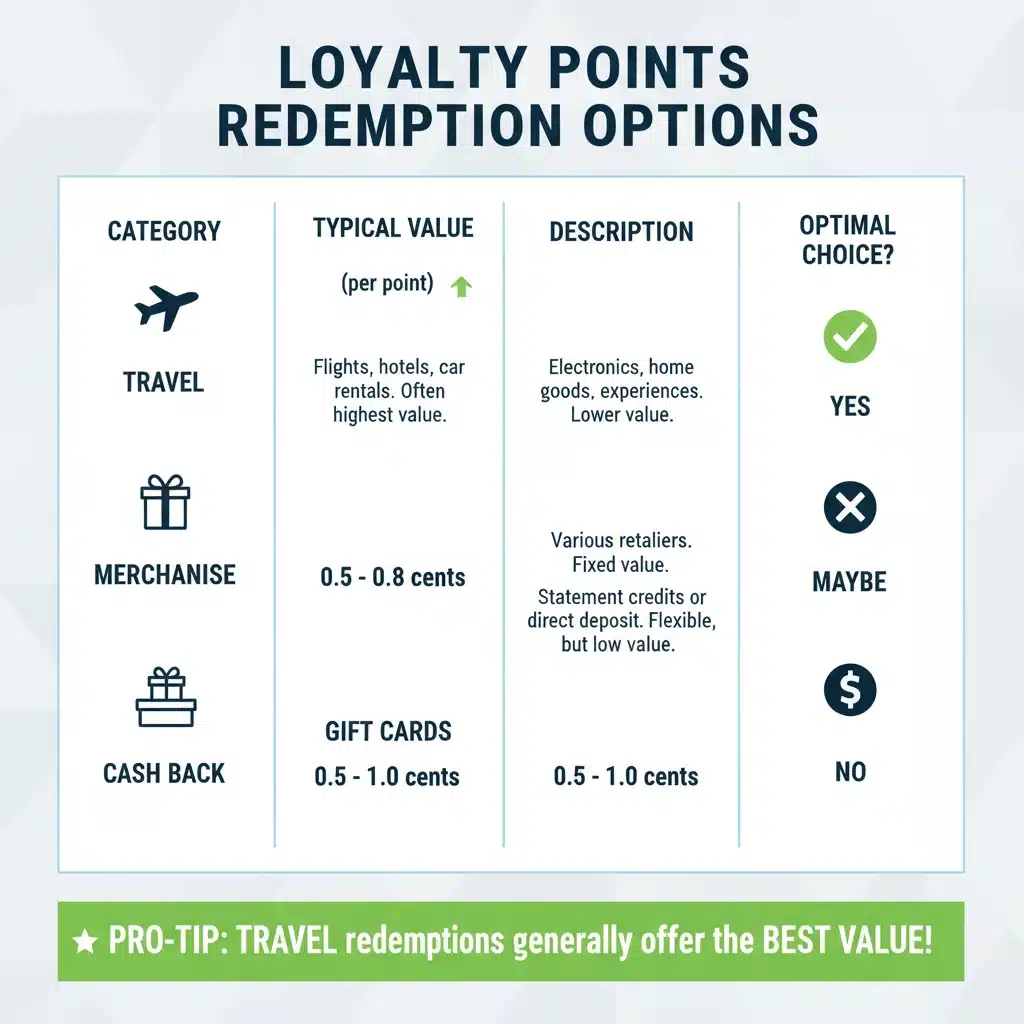
- Redemption Type: Travel (flights, hotels) almost always offers the best value. Gift cards, merchandise, and cash back typically yield lower returns.
- Program Specifics: Each loyalty program has its own redemption chart and partners, influencing value.
- Demand and Seasonality: During peak travel seasons or for high-demand routes, cash prices soar, potentially increasing your CPP if the points requirement doesn’t increase proportionally (or if you’re using a fixed-rate award chart).
- Promotions and Bonuses: Keep an eye out for limited-time offers where programs might offer a discount on points redemptions or bonus points for certain activities.
Strategic Redemption Channels for 10%+ Higher Value
To consistently hit that 10% higher value target for your loyalty points redemption, you need to focus on specific redemption channels that historically offer superior returns. These are the practical solutions that will make a tangible financial impact.
1. Leveraging Flexible Points Currencies and Transfer Partners
This is arguably the most powerful strategy. Flexible points programs like Chase Ultimate Rewards, American Express Membership Rewards, and Citi ThankYou Points allow you to transfer your points to various airline and hotel loyalty programs. This flexibility is key:
- Airline Transfers: Transferring points to airline partners often unlocks premium cabin travel (business and first class) at a fraction of the cash cost. A $10,000 business class ticket might cost 100,000 points + fees, yielding a staggering 10 CPP. Even economy flights can offer excellent value, especially for international routes or during sales.
- Hotel Transfers: While generally less valuable than airline transfers, hotel partners can be great for luxury stays or when cash rates are exceptionally high. Look for sweet spots in award charts or promotional deals.
- Transfer Bonuses: Periodically, these programs offer bonuses (e.g., 20% or 30% extra points) when you transfer to a specific partner. Timing your transfers with these bonuses can instantly boost your redemption value by a significant margin. A 25% transfer bonus on a redemption already yielding 1.5 CPP effectively makes it 1.875 CPP, a substantial increase.
2. Maximizing Airline Award Charts and Sweet Spots
Despite the move to dynamic pricing, some airlines still utilize award charts or have ‘sweet spots’ – specific routes or regions where the points required are disproportionately low compared to the cash price. Researching these can lead to exceptional loyalty points redemption values:
- Alliance Partners: Don’t just look at the airline you’re transferring to. Explore their alliance partners (Star Alliance, Oneworld, SkyTeam). You might transfer points to United Airlines, but redeem them for a flight on Lufthansa or Singapore Airlines, often at a better rate.
- Region-Based Charts: Some older award charts still price flights based on regions, making long-haul flights within or between certain regions incredibly cheap in points.
- Stopovers and Open-Jaws: Some programs allow stopovers or open-jaws on award tickets, letting you visit multiple destinations for the price of one, further enhancing value.
3. Strategic Hotel Redemptions: Free Night Certificates & Category Sweet Spots
Hotel loyalty programs also offer avenues for high-value loyalty points redemption:
- Free Night Certificates: Many hotel credit cards offer annual free night certificates. Using these at hotels where the cash rate is high (e.g., $300-$500 per night) provides immense value, often far exceeding the annual fee of the card.
- Fifth Night Free (or similar): Programs like Marriott Bonvoy and Hilton Honors offer a free night when you book a certain number of nights with points (e.g., 5th night free). This automatically boosts your per-point value for longer stays.
- Category Sweet Spots: Similar to airlines, certain hotel categories or specific properties might consistently offer better value than others for point redemptions. Researching these can lead to luxury stays at budget-friendly point prices.
4. Leveraging Credit Card Travel Portals (with caution)
Some credit cards (e.g., Chase Sapphire Reserve, Amex Platinum) offer enhanced value when redeeming points through their proprietary travel portals. For example, Chase Sapphire Reserve holders get 1.5 CPP when booking travel through the Chase Ultimate Rewards portal. While this is a decent fixed value, it typically doesn’t reach the ultra-high values possible with transfer partners for premium travel. Use it when transfer partners aren’t available for your desired route or if cash prices are exceptionally low, making award availability scarce.
Advanced Tactics for Maximizing Loyalty Points Redemption
Beyond the core strategies, several advanced tactics can help you squeeze every last drop of value from your points, ensuring you consistently hit that 10%+ higher value mark for your loyalty points redemption.
1. Timing Your Redemptions: The Art of Patience and Opportunity
- Devaluation Watch: Keep an eye on loyalty program announcements. Programs often give notice before devaluations. Redeeming before a devaluation can save you thousands of points.
- Promotional Sales: Airlines and hotels frequently offer limited-time sales on award travel. Subscribing to newsletters and following loyalty blogs can alert you to these opportunities.
- Off-Peak Travel: For programs with peak/off-peak pricing, traveling during off-peak windows can drastically reduce the points required, significantly boosting your CPP.
- Last-Minute Availability: Sometimes, airlines release more award seats closer to departure, especially for premium cabins. If you’re flexible, this can be a goldmine.
2. The Power of Blended Bookings
Sometimes, the best redemption isn’t purely points or purely cash. Consider a ‘blended’ approach:
- Points + Cash: Many programs allow you to combine points and cash for a redemption. While the cash portion might not always be the best value, it can be useful if you’re short on points for a high-value redemption. Carefully calculate the CPP of the points portion to ensure it’s still a good deal.
- Combining Programs: For a complex itinerary, you might use airline miles for one leg of a journey and hotel points for another, or use a free night certificate for one night and points for the rest. This strategic combination maximizes value across different loyalty ecosystems.
3. Understanding and Minimizing Fees and Surcharges
Award tickets often come with taxes, fees, and sometimes fuel surcharges. These can eat into your redemption value. To ensure a 10%+ higher value for your loyalty points redemption:
- Choose Airlines Wisely: Some airlines (e.g., British Airways, Lufthansa for long-haul) are notorious for high fuel surcharges on award tickets. Others (e.g., United, Singapore Airlines, Virgin Atlantic on certain routes) have much lower or no surcharges.
- Use Points for Fees (if valuable): Occasionally, you might have the option to use points to cover taxes and fees. Only do this if the CPP for those specific points is good. Otherwise, pay with cash to preserve your high-value points for the main redemption.
- Credit Card Benefits: Some premium credit cards offer travel credits that can offset award taxes and fees.
4. Monitoring and Utilizing Program Changes
Loyalty programs are not static. Changes in award charts, transfer ratios, or partner agreements can drastically alter redemption values. Proactive monitoring is crucial for 2026:
- Subscribe to Industry News: Follow reputable loyalty blogs and news sites. They often break news about upcoming changes well in advance.
- Review Program Terms Annually: Make it a habit to quickly review the terms and conditions of your primary loyalty programs at least once a year.
- Leverage New Partnerships: When a new transfer partner or airline alliance member is announced, evaluate if it creates new high-value loyalty points redemption opportunities.
Case Studies: Achieving 10%+ Higher Value in Practice
Let’s look at some hypothetical scenarios for 2026 that illustrate how to achieve superior loyalty points redemption value:
Case Study 1: International Business Class Flight
- Goal: Business class flight from New York to Paris, cash price $4,000.
- Standard Redemption (through credit card portal at 1.5 CPP): $4,000 / $0.015 = 266,667 points.
- Optimized Redemption (transfer partner with bonus): Transfer 70,000 Chase Ultimate Rewards points to Virgin Atlantic during a 30% transfer bonus (totaling 91,000 Virgin points). Redeem 91,000 Virgin points for a Delta One (Business Class) flight to Paris (assuming availability and lower surcharges).
- Value Achieved: ($4,000 / 91,000) * 100 = 4.4 CPP. This is significantly higher than the 1.5 CPP baseline and far exceeds the 10% target. The financial impact is a direct saving of over $2,900 compared to the cash price, or a massive increase in value compared to portal redemption.
Case Study 2: Luxury Hotel Stay
- Goal: 4-night stay at a luxury hotel in Kyoto, Japan, cash price $600/night ($2,400 total).
- Standard Redemption (through credit card portal at 1 CPP): $2,400 / $0.01 = 240,000 points.
- Optimized Redemption (hotel program with 5th night free + strategic category): Transfer flexible points to Marriott Bonvoy. Find a Category 6 Marriott property that costs 50,000 points/night. Book 4 nights for 200,000 points and get the 5th night free (total 5 nights). For our 4-night goal, this means we’ve effectively paid for 3 nights for 4 nights of value. Let’s assume we find a 4-night redemption at 50,000 points/night = 200,000 points.
- Value Achieved: ($2,400 / 200,000) * 100 = 1.2 CPP. While lower than the airline example, this is still 20% higher than the baseline 1 CPP and a solid financial win for a luxury experience. If we had stayed 5 nights, the 5th night free would have made it even better: ($3,000 / 200,000) * 100 = 1.5 CPP.
These examples highlight that achieving a 10%+ higher value for your loyalty points redemption is not only possible but, with strategic planning, can lead to substantial gains.

Common Pitfalls to Avoid in Loyalty Points Redemption
While the opportunities are vast, there are also common traps that can diminish the value of your loyalty points redemption. Being aware of these can save you from costly mistakes:
- Redeeming for Low-Value Options: Gift cards, merchandise, and cash back (unless explicitly stated as a high-value option for your specific card) almost always offer the worst value. Avoid these unless absolutely necessary.
- Ignoring Expiration Dates: Points can expire! Always be aware of the expiration policies of your programs and plan redemptions or activity to keep them active.
- Transferring Without a Plan: Once points are transferred to an airline or hotel program, they generally cannot be transferred back. Only transfer when you have a specific redemption in mind and have confirmed availability.
- Paying Excessive Fees: As discussed, high fuel surcharges can negate the value of an award ticket. Always factor in cash out-of-pocket costs when calculating your CPP.
- Not Comparing Cash Prices: Always check the cash price of the flight or hotel you’re considering. Sometimes, cash sales can be so good that paying with cash and saving your points for a higher-value redemption makes more sense.
- Over-Accumulating in One Program: While concentration can sometimes be good, having all your points in one non-flexible program can limit your options if that program undergoes a devaluation or eliminates a valuable partner. Diversify or focus on flexible points.
Maintaining Your Edge: Tools and Resources for 2026
To consistently achieve 10%+ higher value for your loyalty points redemption in 2026, you’ll need to stay informed and utilize the right tools:
- Loyalty Program Blogs & Forums: Websites like The Points Guy, Doctor of Credit, One Mile at the Time, and Flyertalk forums are invaluable resources for news, strategies, and community discussions.
- Award Search Tools: Tools like AwardHacker, Point.me, or specific airline/alliance award search engines can help you find award availability and compare redemption options across different programs.
- Spreadsheets/Tracking Apps: Keep track of your points balances, expiration dates, and target redemptions. A simple spreadsheet can be incredibly effective.
- Email Newsletters: Subscribe to newsletters from your credit card issuers and loyalty programs to be informed of promotions and changes.
- Credit Card Strategy: Continuously evaluate your credit card portfolio. Are your cards earning the right type of points for your redemption goals? Are you maximizing category bonuses?
Financial Impact: The True Value of Smart Redemption
Achieving a 10% higher value on your loyalty points redemption isn’t just a game; it has a real and tangible financial impact. Consider this:
- If you earn 100,000 points per year, and you consistently redeem them at 1.5 CPP instead of 1 CPP, you’ve effectively generated an extra $500 in value annually.
- Over five years, that’s $2,500 in additional value – money that can be used for other financial goals, investments, or simply enjoyed without dipping into your cash savings.
- For premium travel redemptions where you might achieve 3-5 CPP, the savings can be thousands of dollars on a single trip, enabling experiences that would otherwise be out of reach.
This isn’t about getting something for nothing; it’s about optimizing the rewards you’ve already earned. It’s a form of smart personal finance that turns what could be a negligible benefit into a significant financial asset.
Conclusion: Master Your Loyalty Points Redemption in 2026
The journey to mastering loyalty points redemption for 2026 is one of continuous learning, strategic planning, and diligent execution. By understanding point valuations, focusing on high-value transfer partners, leveraging award chart sweet spots, and avoiding common pitfalls, you can confidently aim for and consistently achieve a 10% or even greater increase in the value of your points. The financial rewards are clear: more travel, better experiences, and greater financial freedom. Start implementing these strategies today, and transform your loyalty points into an incredibly powerful tool for your future adventures and savings.