Achieve Financial Freedom: Your 2026 Savings Plan for Automatic 10% Income Allocation
Your 2026 Savings Plan: A Step-by-Step Guide to Allocating 10% of Your Income Automatically
In an increasingly unpredictable world, the importance of a robust financial safety net cannot be overstated. While many aspire to save more, the execution often proves challenging. This is where an effective automatic savings plan comes into play. Imagine a future where 10% of your income is consistently and effortlessly channeled into your savings, building your wealth without you having to lift a finger each payday. This comprehensive guide will walk you through the essential steps to implement a powerful 2026 savings plan, ensuring you automatically allocate a significant portion of your income towards your financial goals.
The year 2026 isn’t just a number; it’s a future milestone. By setting our sights on this specific timeframe, we can establish clear objectives and actionable strategies. Our focus is on making the process of saving not just easy, but truly automatic, transforming a daunting task into a seamless habit. Let’s delve into how you can make this a reality.
Understanding the Power of an Automatic Savings Plan
Before we dive into the ‘how,’ let’s briefly touch upon the ‘why.’ Why is an automatic savings plan so crucial for your financial well-being? The answer lies in human psychology and practical mechanics. We are creatures of habit, and often, our financial decisions are driven by immediate gratification rather than long-term goals. Manual saving requires conscious effort, discipline, and often, willpower – resources that can be depleted by daily stresses.
Automation bypasses these psychological hurdles. By setting up a system where a portion of your income is transferred to savings the moment it hits your account, you effectively ‘pay yourself first.’ This strategy ensures that your savings goals are prioritized, rather than being an afterthought. It eliminates the temptation to spend money that hasn’t even been designated for savings, fostering a disciplined approach without the constant mental battle.
Moreover, an automatic savings plan leverages the power of compounding. The sooner your money starts working for you, the more it grows over time. Even small, consistent contributions can accumulate into substantial sums, especially when invested wisely. This hands-off approach allows you to focus on other aspects of your life, confident that your financial future is being steadily built in the background.
The Psychology Behind ‘Paying Yourself First’
The concept of ‘paying yourself first’ is a cornerstone of personal finance, and it’s the bedrock of any successful automatic savings plan. It flips the traditional budgeting model on its head. Instead of paying all your bills and then saving whatever is left (which, for many, is often nothing), you prioritize your future self by allocating funds to savings right away. This simple shift in perspective has profound implications for your financial health.
When you automate your savings, you’re essentially treating your savings account as another essential bill. Just as you wouldn’t miss a rent or mortgage payment, you shouldn’t miss a payment to your future self. This mental reframing helps solidify the habit and makes it less likely for you to dip into your savings for non-essential expenses. It creates a powerful psychological barrier against impulsive spending, reinforcing the idea that your financial security is a non-negotiable priority.
Step 1: Assess Your Current Financial Landscape
Before you can effectively implement any automatic savings plan, you need to understand where your money is currently going. This involves a thorough assessment of your income and expenses. Don’t skip this step; it’s foundational to creating a realistic and sustainable plan.
Track Your Income
Begin by clearly identifying all your sources of income. This includes your primary salary, any side hustle earnings, rental income, or other regular payments. Make a list of your gross and net income. Knowing your precise net income is crucial, as this is the amount you’ll be working with for your 10% allocation.
Analyze Your Spending Habits
This is often the most revealing part of the process. For at least a month, meticulously track every single dollar you spend. You can use budgeting apps, spreadsheets, or even a simple notebook. Categorize your expenses into fixed costs (rent, loan payments, subscriptions) and variable costs (groceries, entertainment, dining out). Be honest with yourself; the goal here is not to judge, but to gain clarity.
Many people are surprised by how much they spend on seemingly small, discretionary items. These ‘leakage’ points are often where you can find opportunities to free up funds for your automatic savings plan.
Identify Your Financial Goals for 2026 and Beyond
Why are you saving? Is it for a down payment on a house, retirement, a child’s education, an emergency fund, or a dream vacation? Having clear, specific financial goals provides motivation and direction. Your 2026 savings target of 10% of your income should ideally contribute to these larger objectives. Break down your larger goals into smaller, achievable milestones. For instance, if you want to save for a down payment in 5 years, how much do you need to save each year, and therefore, each month?
Step 2: Crafting Your 2026 Budget with a 10% Savings Target
With a clear understanding of your income and expenses, it’s time to build a budget that incorporates your 10% automatic savings plan. This isn’t about deprivation; it’s about intentional spending and aligning your money with your values.
The 50/30/20 Rule as a Guideline
A popular budgeting framework is the 50/30/20 rule: 50% of your income goes to needs, 30% to wants, and 20% to savings and debt repayment. While our goal is a minimum of 10% for savings, this rule provides a useful benchmark. If you can allocate 20% to savings and debt repayment, you’re in an excellent position. If not, aiming for 10% is a fantastic start.
- 50% Needs: Housing, utilities, groceries, transportation, insurance, minimum debt payments. These are non-negotiable expenses.
- 30% Wants: Dining out, entertainment, hobbies, travel, new gadgets, subscriptions (beyond essentials). These are discretionary expenses that can be adjusted.
- 20% Savings & Debt Repayment: This is where your 10% automatic savings plan will reside, alongside any extra debt payments you make beyond the minimum.
Optimizing Your Expenses to Free Up Funds
Once you have your categories, look for areas where you can reduce spending, especially in the ‘wants’ category. Even small adjustments can add up significantly over time.
- Review subscriptions: Are you using all your streaming services or gym memberships? Cancel those you don’t use.
- Negotiate bills: Call your internet, cable, and insurance providers to see if you can get a better rate.
- Reduce dining out: Cooking at home is almost always cheaper and often healthier.
- Cut impulse purchases: Implement a ’24-hour rule’ before buying non-essential items.
- Seek cheaper alternatives: Can you find a more affordable phone plan or consolidate debt?
The goal is to create enough wiggle room in your budget to comfortably accommodate that 10% automatic transfer without feeling overly restricted. Remember, this is about sustainable change, not temporary sacrifice.
Step 3: Setting Up Your Automatic Savings Plan
This is the core of our 2026 savings plan. Automation is key to consistency and long-term success. Most banks and financial institutions offer robust tools to facilitate this.
Choose the Right Savings Vehicle
Where will your 10% automatically go? Consider these options:
- High-Yield Savings Account (HYSA): These offer better interest rates than traditional savings accounts, meaning your money grows faster. Look for HYSAs with no monthly fees and easy access to funds if needed.
- Investment Account: If your emergency fund is already robust, consider directing a portion of your automatic savings plan into a low-cost index fund or ETF. This allows your money to grow more aggressively over the long term.
- Retirement Accounts (401(k), IRA): If your employer offers a 401(k) match, contributing at least enough to get the full match should be a top priority, as it’s essentially free money. IRAs also offer tax advantages for retirement savings.
- Specific Goal Accounts: Some banks allow you to create sub-accounts within your main savings account for specific goals (e.g., ‘House Down Payment,’ ‘Vacation Fund’). This can be highly motivating.
Configure Automatic Transfers
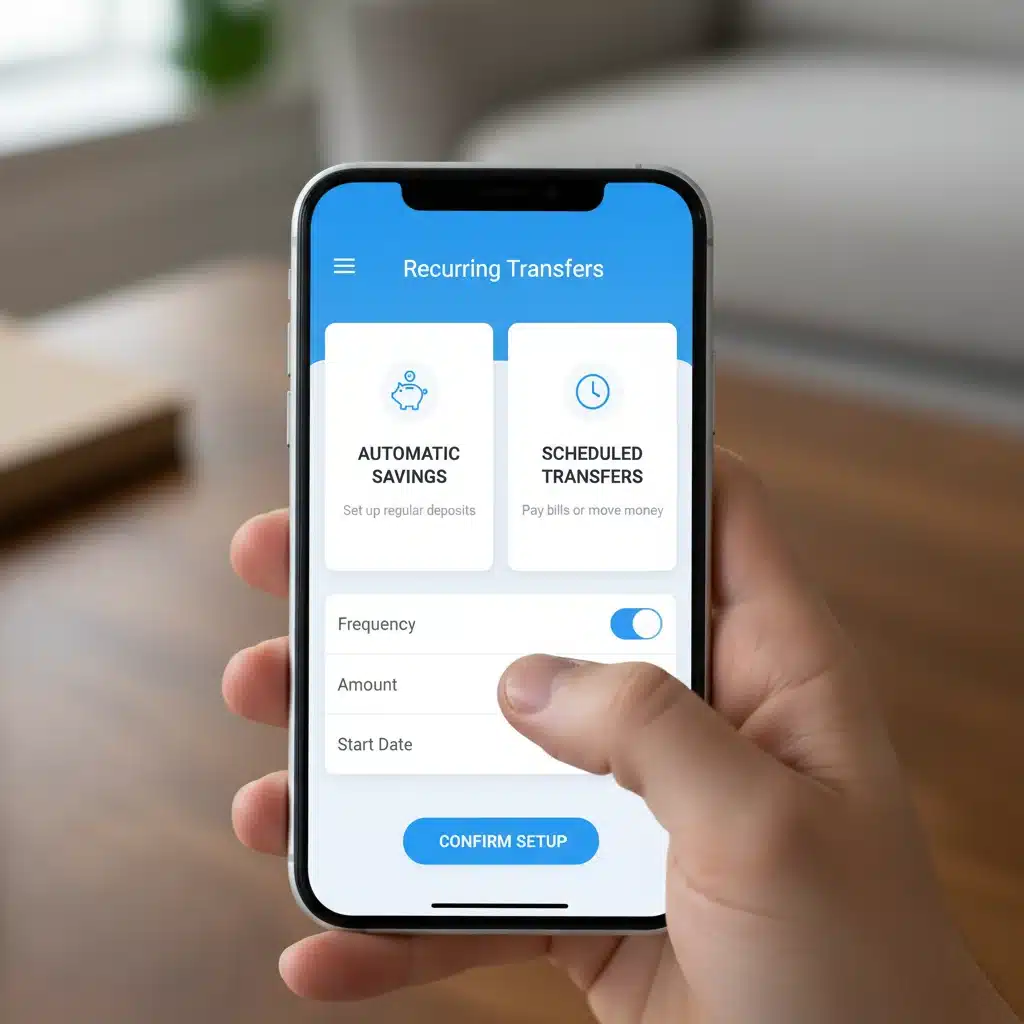
Once you’ve chosen your savings vehicle, set up recurring transfers. This is usually done through your online banking portal or mobile app. Here’s how:
- Determine the amount: Calculate 10% of your net income. If your income varies, use an average or a conservative estimate.
- Choose the frequency: Align the transfer with your pay schedule. If you get paid bi-weekly, set up bi-weekly transfers. If monthly, set up monthly transfers. The goal is for the money to move *before* you have a chance to spend it.
- Select the transfer date: Ideally, set the transfer to occur on the same day your paycheck hits your checking account, or one day after. This ensures the funds are moved immediately.
- Confirm and monitor: Double-check the transfer details and set up alerts to confirm successful transfers.
Leveraging Employer-Sponsored Plans
For retirement savings, many employers allow you to directly allocate a percentage of your paycheck to your 401(k) or similar plan. This is the ultimate form of an automatic savings plan, as the money never even touches your checking account, reducing any temptation to spend it. If available, take full advantage of this feature. Even if you’re already contributing, consider increasing your percentage to reach or exceed your 10% goal.
Step 4: Monitoring, Adjusting, and Optimizing Your Plan
An automatic savings plan isn’t a ‘set it and forget it’ solution entirely. While the automation handles the heavy lifting, regular monitoring and occasional adjustments are vital to ensure it remains effective and aligned with your evolving financial situation.
Regularly Review Your Budget and Spending
Schedule a monthly or quarterly financial review. Look at your income, expenses, and savings progress. Are you consistently hitting your 10% target? Are there new expenses or income changes that require adjustments to your budget?
This review is also an opportunity to identify new ways to save. Perhaps you’ve found a cheaper grocery store, or you’ve cut down on an expensive habit. Reallocate those freed-up funds directly into your automatic savings plan, potentially increasing your savings rate beyond 10%.
Increase Your Savings Rate When Possible
Whenever you experience a financial windfall – a raise, a bonus, a tax refund – consider increasing your automatic savings plan. Even a small bump from 10% to 11% or 12% can make a significant difference over time. Make it a habit to automatically save a portion of any unexpected income.
Adjust for Life Changes
Life is dynamic, and your financial plan should be too. Major life events like marriage, having children, buying a house, or changing jobs will impact your income and expenses. Be prepared to reassess and adjust your automatic savings plan accordingly. The goal is to maintain consistency in saving, even if the absolute amount or percentage needs to shift temporarily.
For example, if you face a temporary reduction in income, you might need to lower your automatic transfer amount to avoid overdrafts. The key is to resume your target 10% or even higher as soon as your financial situation stabilizes.
Step 5: Overcoming Common Obstacles to Automatic Savings
Even with the best intentions, challenges can arise. Being aware of these potential hurdles allows you to proactively address them.
The ‘Not Enough Money’ Mindset
This is perhaps the most common barrier. Many believe they simply don’t earn enough to save 10%. While it’s true that some individuals face severe financial hardship, for many, this mindset is a reflection of uncontrolled spending rather than insufficient income. Go back to Step 2 and rigorously optimize your budget. You might be surprised at how much ‘extra’ money you can find when you truly scrutinize your spending. Start small if 10% feels impossible; even 1% or 2% is better than nothing, and you can gradually increase it.
Lack of Discipline
While automation minimizes the need for daily discipline, you still need the initial discipline to set up the system and resist the urge to transfer money back from your savings. Create friction points: make your savings account slightly less accessible than your checking account, or choose a bank that doesn’t offer instant transfers from savings to checking. This extra step can deter impulsive withdrawals.
Unexpected Expenses
Life happens. Car repairs, medical bills, or home emergencies can derail even the best-laid plans. This is precisely why an emergency fund is critical. Before aggressively investing, ensure you have 3-6 months’ worth of living expenses saved in an easily accessible, high-yield savings account. This fund acts as a buffer, preventing you from having to dip into your long-term savings or go into debt when unforeseen costs arise. Your automatic savings plan should prioritize building this fund first.
Advanced Strategies for Supercharging Your Automatic Savings
Once you’ve mastered the basic 10% automatic savings plan, consider these advanced tactics to accelerate your wealth building for 2026 and beyond.
Automate Savings from Windfalls
As mentioned, don’t let bonuses, tax refunds, or unexpected gifts disappear into your everyday spending. Decide beforehand to automatically transfer a significant portion (e.g., 50% or even 100%) of these windfalls directly into your savings or investment accounts. This is ‘found money’ that can dramatically boost your progress without impacting your regular budget.
The ‘Round-Up’ Feature
Many banking apps and fintech services offer a ’round-up’ feature. This automatically rounds up your purchases to the nearest dollar and transfers the difference to a savings account. While individual amounts are small, they accumulate surprisingly quickly and painlessly. It’s a subtle yet effective addition to your automatic savings plan.
Automate Debt Repayment (Beyond Minimums)
While technically not savings, aggressively paying down high-interest debt (like credit card debt) can be considered a form of ‘saving’ because it frees up future income that would otherwise go to interest payments. Set up automatic extra payments on your high-interest debts alongside your regular savings transfers. This dual approach tackles both sides of your financial ledger effectively.
Automate Investment Contributions
Once your emergency fund is solid, shift your focus to automating investments. Set up recurring transfers from your checking account to a brokerage account, contributing to low-cost index funds, ETFs, or mutual funds. This puts your money to work, leveraging market growth and compounding over the long term. This is a critical component of any robust automatic savings plan aimed at true wealth accumulation.
Consider a Separate Financial Institution for Savings
Some people find it helpful to have their primary checking account at one bank and their savings (especially long-term savings or emergency fund) at a completely different institution. This creates a psychological and practical barrier, making it less convenient to impulsively transfer money back to checking. It reinforces the idea that your savings are ‘out of sight, out of mind’ and dedicated to their specific purpose.
The Long-Term Benefits of Your 2026 Automatic Savings Plan
Implementing a consistent automatic savings plan by 2026 will set you on a trajectory toward profound financial benefits:
- Reduced Financial Stress: Knowing you have a growing safety net provides immense peace of mind.
- Attainment of Financial Goals: Whether it’s a home, retirement, or education, consistent saving makes these dreams tangible.
- Increased Financial Literacy: The process of budgeting and automating will naturally enhance your understanding of personal finance.
- Greater Financial Freedom: As your wealth grows, you gain more choices and control over your life.
- Preparation for the Unexpected: An emergency fund built through automation ensures you’re ready for life’s inevitable curveballs.
The journey to financial security is a marathon, not a sprint. However, with a well-structured automatic savings plan, you’re not just running the race; you’re doing so with a powerful tailwind. By 2026, you could be well on your way to achieving significant financial milestones, all thanks to the simple yet profound act of consistently paying yourself first.
Conclusion: Make 2026 Your Year for Financial Transformation
Taking control of your finances might seem daunting, but by focusing on one achievable goal – automatically saving 10% of your income – you can initiate a powerful transformation. This 2026 savings plan is designed not just to help you save money, but to fundamentally alter your relationship with it. It’s about building habits that serve your long-term well-being, rather than succumbing to short-term impulses.
Start today. Assess your finances, create a realistic budget, and most importantly, set up those automatic transfers. The future you, thriving with financial security and peace of mind, will thank you. Embrace the power of automation and watch your savings grow, propelling you towards your financial aspirations in 2026 and for many years to come.